Overview
‘Exceptional’, ‘Challenging’, ‘Bountiful’, ‘Lousy’. These are just a few ways winemakers described the 2023 vintage in England and Wales. It was a year that broke a variety of records and challenged winemakers in new and unexpected ways. Amongst the rewards of the year were almost ubiquitous high yields, a welcome change after several years of smaller harvests. The quality, as well as quantity, of the 2023 vintage was also praised, with many vineyards reporting an ‘excellent’ vintage. Chardonnay in particular was widely lauded, with several winemakers reporting that this year’s crop was the best they had ever seen.
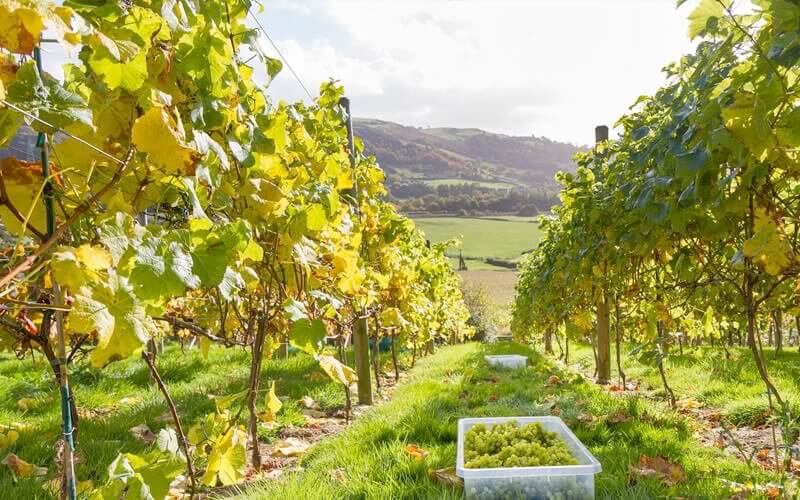
2023 was also a year, however, that brought its fair share of challenging, and even desperate, moments. With the critical months of July and August characterised by relentlessly cool and damp conditions, 2023 was a far cry from the largely uninterrupted sunshine of 2022 and was consequently no easy vintage to handle. Concerns over ripeness, acidity levels and the general longevity of 2023 wines have all been expressed. At Grape Britannia, we’re looking forward to trying our first 2023 wines later this year and, while we’ll be alert to all these issues and more, we’re confident that there should be many fantastic wines for our customers to look forward to.
Growing Season
The year began in a mild sort of way, with an unsettled January giving way to the driest February since 1993, during which central and southern England recorded 20% less rainfall than average. In contrast, the following month proved to be the sixth wettest March ever recorded in the UK. Throughout, the temperature was stubbornly low and remained so until late May. Despite this, frost was mercifully rare, and what instances there were tended to be, as Nyetimber reported, ‘minor and localised’. Vineyards such as Hattingley reported increased disease pressure from early botrytis, downy mildew and phomopsis, as they weathered nearly 80mm of rain between April and May. Broadly speaking however, early spring conditions were favourable, with vineyards such as Artelium reporting good bud burst in late April. Everflyht also noted the absence of frost in April and May, meaning that the Sussex vineyard retained ‘almost all of their primary buds fully laden with two clusters’. Everflyht attributed this particularly bountiful growth in part to the very warm conditions in 2022 (primary buds develop in the preceding year, and the warm conditions encouraged good cluster growth).
Nevertheless, the warmth of 2022 remained mostly a memory in May, during which the weather was cool and damp. And then came June, the first of several curveballs from the 2023 summer, when temperatures spiked in a month that, according to the Met Office, ‘bore the fingerprints of climate change’. Vineyards across the country welcomed this heatwave. At Roebuck, ‘the warm weather in June accelerated shoot growth, and the final 10 days showcased marvellous flowering’, while Oxney reported that ‘the heat brought on so much rapid growth’ that the vineyard ‘could barely keep up with canopy management’. Simpsons reported a ‘beautifully warm, dry and settled flowering period’ in June, while Hattingley noted that that the spell of warm dry weather helped ‘make up for a slow start’.
However, after such promising beginnings, July and August proved much more complicated. In stark contrast to the previous year, temperatures slumped in July, bringing rain and unsettled weather. Three Choirs noted that ‘July onwards will not go down as our best summer and autumn’, while Heppington were a little more blunt, describing the summer (except for June) as ‘lousy’. The weather certainly made for difficult conditions in the vineyard. Albury noted that the wet weather caused their fruit to swell with water, such that they worried ‘mildew would hit the fruit’. Artelium likewise expressed ‘concern around disease pressure’, although ‘no big issues materialised’, while Oxney reported challenges keeping ‘powdery and downy mildew at bay’, which they combatted with their ‘organic spray programme’. Ancre Hill meanwhile stated that disease pressure was ameliorated by ‘rigorous canopy management’, which helped keep ‘everything aerated, dry and exposed to maximum sunlight’. Albourne similarly reported that the conditions required ‘comprehensive canopy management work’ and a ‘timely and well executed spray programme’.
As the challenging conditions endured, concerns about ripeness and acidity became widespread. Chris Wilson of Gutter and Stars argued in an interview with The Buyer that ‘in many parts of the country… vines struggled to achieve the ripeness levels needed for quality wine’. He noted that, in some instances, the ‘abundance of fruit on the vine hindered the vine’s attempt to ripen…. leaving underripe grapes with high acids’. Conversely, he also noted that elsewhere, acids were ‘diluted by rain’, while the rain meant sugars never reached optimum levels. It was, he observed, ‘not ideal in either case’. Everflyht reported that ‘what looked like a fantastic vintage at the start of July’ had, by mid August, ‘become one of the hardest’, and they began to fear they may have to drop as much as ’30-40% of their fruit’ to help the remaining grapes ripen. Heppington similarly reported fears of a ‘huge but under ripe crop’. Chris Wilson notes that ‘some viticulturists were ahead of the game’ and began ‘dropping fruit early in the season – especially on Chardonnay and Pinot Noir vines for still wine production’.
However, 2023 still had a few tricks left up its sleeve, as September arrived with a late heatwave (Everflyht described it ‘like the cavalry coming over the hill to the rescue’). This Indian summer was welcomed by vineyards throughout the country, bringing much needed sunshine and warmth to help grapes fully ripen. Heppington notes that they were ‘rescued’ by the weather in September, while the late spell of heat provided ‘perfect ripening weather’ for Roebuck. Chris Wilson similarly notes that the ‘dry and warm’ September helped to ‘push the sugars, acids and- crucially- flavours into the right place’. Indeed, Albourne reported that ‘the intensity and length of the heat wave nearly led to over-ripening in some varietals- especially for sparkling wine’. Into October however, conditions in some areas became more troubled, with Hattingley reporting that they had to spray organic product twice as often as usual to counteract the disease risk.
Harvests typically took place throughout late September and, for many vineyards, happened during this welcome period of good weather. Gusbourne commenced their harvest on September 22nd, noting that ‘the spell of warm weather got grapes into a great spot’. At New Hall, conditions during the harvest were ‘absolutely textbook’, while Albury notes that their harvest, ‘which began at the beginning of October’, took place over ‘three weeks of glorious sunshine and blue skies’. Harvests were largely completed by late October, although some vineyards reported finishing as late as early November.
Yields
Perhaps the single most distinctive characteristic of 2023 was the sheer quantity of fruit produced. Nearly every vineyard reported a substantial crop, with many setting new records, in some cases substantially above the previous record. Particularly striking examples include Balfour Hush Heath, which harvested over 820 tonnes of grapes in 2023, requiring over 112 tanks to be called into action. Balfour expect to produce over 870,000 bottles from their 2023 harvest, a 132% increase on 2022, and ‘far beyond any previous record in [Balfour’s] twenty-one year history’. However, even these figures pale in comparison to Chapel Down, England’s largest wine producer, which harvested a record 3,811 tonnes of grapes. This prodigious harvest was 86% higher than their 2022 harvest and 75% higher than their previous record in 2018, and Chapel Down expect to produce an impressive 3.4 million bottles of wine from the 2023 harvest. To put this in perspective, the total production of English and Welsh wines in 2018, one of the most bountiful vintages in recent years, only amounted to 15.6 million bottles. The total production of 2023, by contrast, is likely to be over 20 million bottles (figures from WineGB).

Many vineyards reported that extensive preparation was essential to handle these sizeable harvests. Gusbourne’s Head of Wine Operations Alastair Benham reported that ‘before harvest, we did work to define the maximum volume of fruit we could take in with the size of presses, fermentation capacity, quantity of barrels and so on’. He observes that ‘there might have been a bit of luck at play, but we were pretty much bang on’. Predicting the size of the yield wasn’t always easy though, with Knightor noting that ‘experienced contract vineyards’ were sometimes ‘way out’ on yield predictions, and that ‘actual yield was often 25-30% higher than prediction’, leading to issues with tank space. Hattingley meanwhile reported acquiring new stainless steel fermentation tanks for increased capacity and ‘much tidying to find a use for every inch of space we had at our disposal’.
It should be noted that not all producers reported higher yields. Three Choirs Vineyard noted that their yields were ‘about average’, which they suggested could be due to ‘a combination of reduced acreage and good canopy management (a vigorous green harvest)’. Similarly, Albourne and Simpsons reported broadly average yields.
Labour and Supplies
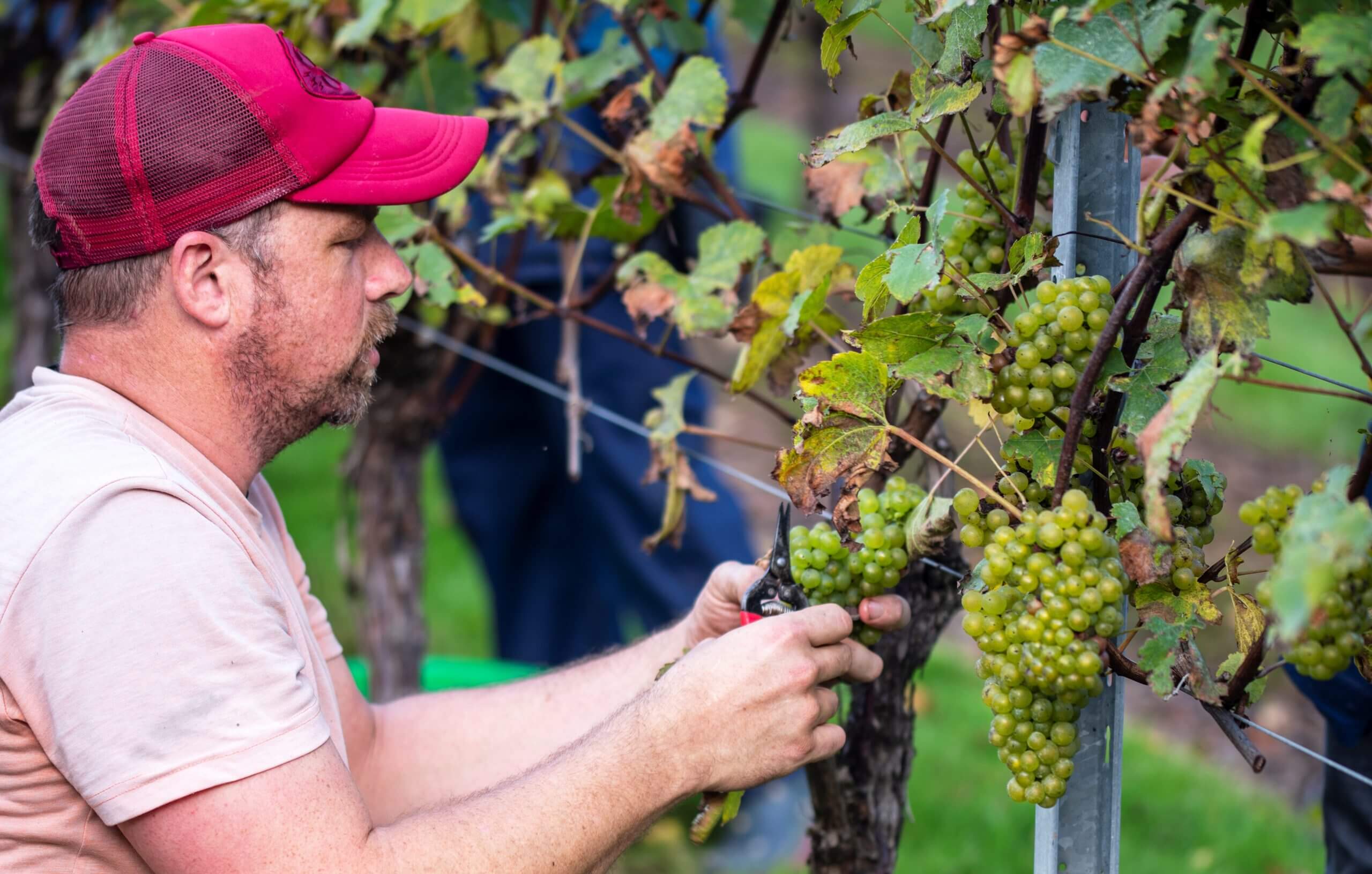
Given the size of the harvest, many vineyards needed to employ a sizeable picking team, but happily there were very few issues with availability of labour. Albury reported that nearly 300 people were involved in their harvest, who were rewarded with a firework display over the Surrey vineyard. Nyetimber meanwhile assembled a team of 400 pickers, all harvesting by hand.
Harvests were not always easy. Woodchester noted, in an observation surely shared by other vineyards, that the year’s ‘unpredictable weather… made picking days difficult to plan’. Winery teams also had their work cut out for them as they handled often record harvests. Artelium reported that ‘many of the team worked four weeks straight without a day off’ to turn the harvest around, while Balfour apparently kept its winery team going with ’57 Cornish pasties, 148 crumpets and 7kg of coffee’!
There were no widespread issues with material shortages reported. However, sporadic challenges were noted, including one vineyard which reported significant impacts on their bottling schedule as a result of glass shortages in 2022, as well as ‘delays in getting bespoke caps, capsules and cages’, which meant some wines ‘had to be bottled at a later date’.
Quality
While The Time’s declaration last December that 2023 was Britain’s ‘best harvest ever’ may be hyperbolic, or at the very least premature, there are certainly suggestions that 2023 produced some good quality juice. Artelium reported that ‘across the board it was an excellent vintage’, while Albury praised an ‘exceptional’ harvest, ‘both in terms of quantity and quality’. While the late summer heatwave was often singled out as a contributor to the eventual quality, some vineyards also suggested that the relatively cool summer had been beneficial for their fruit. Ancre Hill suggested that ‘marginally cooler average temperatures over the season meant slower ripening and a longer time for the grapes on the vine, which all contributed to the development of delicate and complex flavours in the final wines’. Jon Pollard, chief vineyard manager at Gusbourne, made similar observations, noting that the poorer weather in late August ‘slowed down the beginning of the ripening’, which he suggests ‘is no bad thing’. He argued that ‘if we’d had roasting weather through ripening… we probably wouldn’t have seen the same build-up of complexity and aroma compounds in the fruit’.
One frequent observation has been that Chardonnay did particularly well in 2023. Roebuck noted that their Chardonnay grapes have ‘particularly stood out, displaying beautiful ripeness and wonderful aromatics’, and speculated about the possibility of a single vineyard release. Adam Foden, Gusbourne’s Sussex vineyard manager, reported that ‘the Chardonnay especially is outstanding’, while Luke Spalding at Everflyht suggested 2023 was ‘one of the best years I have seen for Chardonnay’.
Challenges
From July onwards, it was clear 2023 wasn’t going to be a trouble-free year, and a variety of vineyards have expressed concerns about the implications of the unusual conditions. The high yields in particular have been the subject of much discussion, and several have suggested that there may be negative consequences for the eventual quality of 2023’s wines.
A useful contribution to the discussion is made by James Dodson at Vineworks, who discussed the relationship between yield and quality in a November blog post. Dodson cautions that, for growers and producers, ‘quality must be the main objective’ and argues that ‘those who got away with a high yield and quality that was ‘just good enough’ risk falling on the wrong side of a fine line’. He notes that many English vineyards saw yields in 2023 in excess of 14t/ha, ‘with some as high as 20t/ha’. This level of yield, he argues, would breach many European PDOs and is certainly in excess of typical UK yields.
It is doubtless the case that, for some vineyards, the large harvests proved a real challenge. One vineyard reported that they had to leave around 15 tonnes of grapes on the vine as they couldn’t find a home for them. Chris Wilson of Gutter and Stars meanwhile reported that ‘every day from mid-September till mid-October there was a phone call or email with an offer of fruit, such was the issue with overcropping.’ He notes carefully ‘I’d be interested to know what happened to all those grapes’.
The impact of the high yields on ripeness and acidity levels has also been a cause of concern. Dodson notes that the ‘extremely wet July and August’ caused ‘dilutions in the juice chemistry’, such as ‘a higher than normal PH of 3.2 and acids consistently at 8Ta [Titratable acidity] or lower’ as well as ‘mixed sugar levels’. He suggests that these issues particularly affected vineyards which overcropped, noting that ‘vineyards that maintained an average yield successfully achieved higher Brix figures [indicative of higher sugar levels]’, while ‘heavy crops struggled to reach acceptable levels’.
Many vineyards did indeed report challenges with ripeness and acidity. Hattingley suggest that ‘if one considers acidity and ripeness to be two of the undeniable factors that contribute to wine quality, then 2023 might come up a bit short in comparison with 2022 or 2014’. Knightor described issues with acidity and ‘aromatic concentration’, particularly in early ripening varieties, which may have had less benefit from the late Indian summer. Danbury Ridge meanwhile reported that several of their contract vineyards overcropped, resulting in massive bunches with ‘uneven or partial ripening’. Even in their home vineyards, they noted it was a year that ‘provided uncharacteristically low acids with a high PH’. However, they also reported good levels of sugars and phenolic ripeness, as well as broadly average yields, potentially suggesting low acidity levels may have more complex causes than just higher yields. Furthermore, Danbury did not express significant concerns about the eventual quality, noting that ‘the Chardonnays have a real intensity to them, and the Pinot already has a plushness’.
One potential impact of these low acidity levels may be that 2023 wines may be more suited for earlier drinking. Hattingley suggest that the vintage ‘could make for some very approachable and gentle English Sparklings, that won’t need excessively long to mature before disgorging’. Three Choirs similarly suggested that their wines from 2023 ‘will be suited to early drinking and will be very approachable at a young age’.
Conclusions
2023 is a difficult vintage to pin down. While 2022 was largely defined by its heat, 2023 is more complex, with the cool summer reminding of 2021, while the warm autumn and high yields are more reminiscent of 2018. Given the complexities of the vintage, this is not a year in which consumers should buy blindly. Issues with ripeness and acidity seem inevitable, and it is likely that decisions by individual vineyard managers and winemakers (e.g. whether to green harvest) will carry more significance than usual in defining the eventual quality.
That said, there is also much to be positive about in 2023. Many vineyards have reported ‘exceptional’ quality across all styles of wine and there are early indications that English and Welsh Chardonnay in particular may be some of the best in recent history. The bumper harvest will mean that, in sheer terms, there is more English and Welsh wine available than ever before and at least one producer has instigated price cuts on some of their wines – a rare thing indeed! Suggestions that 2023 might produce some earlier drinking wines will also doubtless be welcomed in many quarters. While the first tastings of these wines later in 2024 will be the next test, at this stage, we’re confident that 2023 will offer another great selection of English and Welsh wines.
*We’d like to thank all the vineyards who contributed testimonies and 2023 vintage reports. Their time, generosity and honesty are all deeply appreciated. *