Overview
It was, wrote Stephen Skelton MW, ‘a year best forgotten by many growers’. Across England and Wales, vineyards were assailed first by frost, then heavy rain, with very limited sunshine hours. Flowering was poor, disease rampant and the harvest beset by rain. Vineyards took in what they could, but for many, the quality just wasn’t there. For at least one vineyard, the quality was so poor that no wine was made at all.
Without close attention, readers could assume that 2024 is being described here. In fact, the vintage described above is 2012, which remains of the most challenging vintages for English and Welsh wine. But, in many ways, 2024 proved grimly similar to this most challenging of years, bringing even more rainfall, low sunlight hours, and bruising disease pressure. However, while the conditions remained similar, the response to these challenging conditions has been profoundly different. In contrast to 2012, all of the vineyards who spoke to us harvested a crop, and careful vineyard management and winemaking has meant that many of 2024’s wines show real ripeness and phenolic complexity. 2024 will remain one of the more challenging vintages in recent memory, but it is a testament to the skill and dedication of English and Welsh winemakers that we can expect some great wines from these most challenging of conditions.
Growing Season
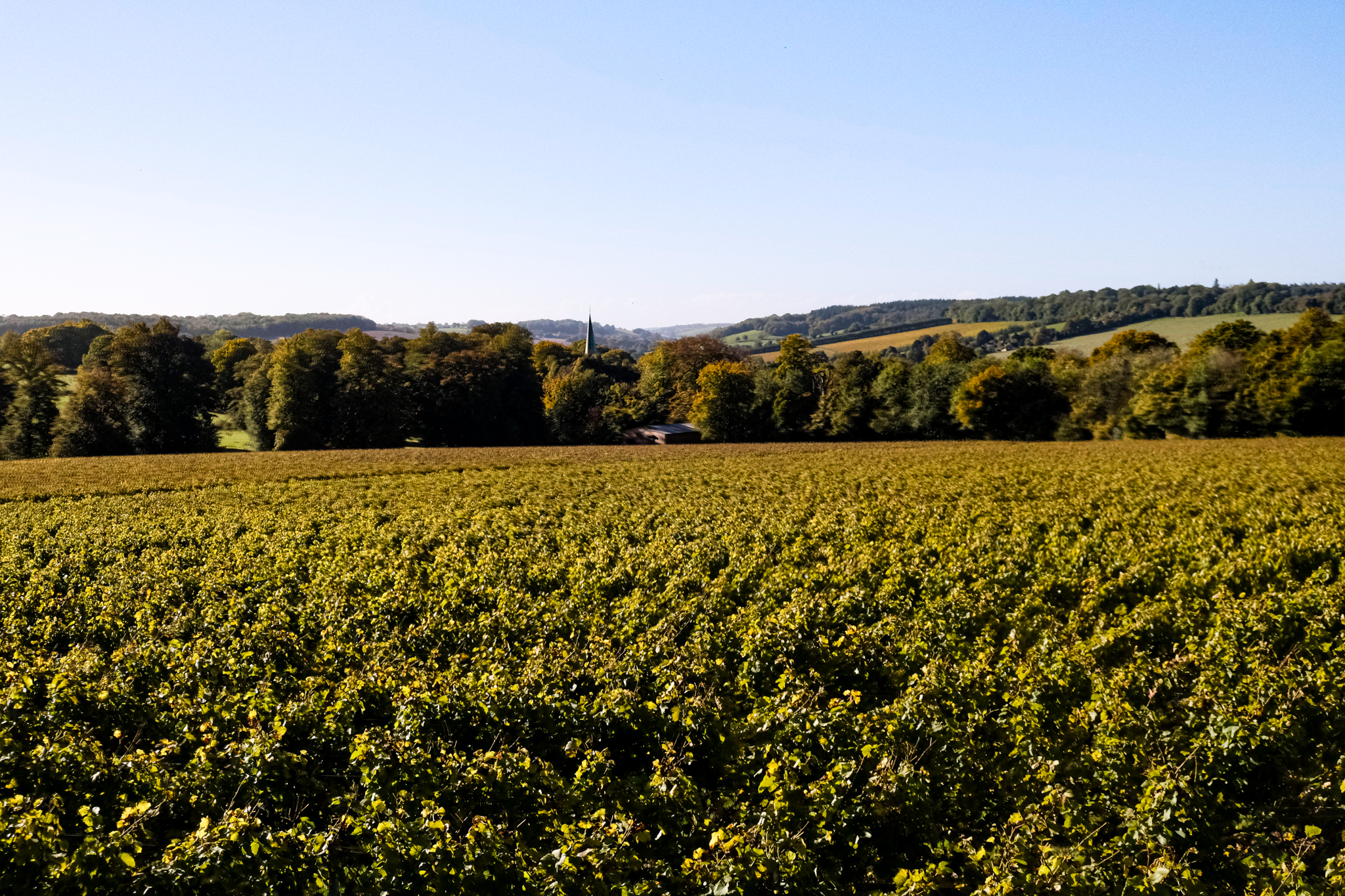
Right from the start, 2024 was notably damp. The winter of 2023 to 2024 is one of the warmest and wettest winters on record in the UK, with January 2024 also yielding the highest ever recorded January temperature (19.9 degrees in Achfary, Southerland). February was similarly mild, setting records as both the warmest February on record for England and Wales and, for the South of England, the wettest, with rainfall reaching 239% of the average. Saffron Grange noted that ‘the eighteen months to the end of March 2024 were the wettest on record for the country since 1836’. Over March and into April, conditions remained unseasonably warm and wet, with Yotes Court Vineyard reporting 414mm of rain during their pruning season.
This mild, turbulent start had mixed effects. Some vineyards, such as Balfour, reported that a ‘mild, wet spring encouraged early growth‘, albeit with ‘increased mildew risk’. Gusbourne similarly experienced budburst earlier than they had in 2023, recording their first Kent budburst on March 26th. For many growers, this early budburst raised fear of frost, which is especially damaging to young buds and, for several vineyards, these fears were not unfounded. Saffron Grange reported a light frost only a day after their first budburst and, on April 25th, suffered a punishing -2.5 degrees frost which ‘despite the hard work of the vineyard team resulted in significant frost damage across the vineyard’. Simpsons reported that, shortly after budburst, their ‘whole team worked in shifts across three nights to protect the fledgling crop from frost damage’. For Simpsons, this largely took the form of bougies, which were deployed for the first time ever across their Railway Hill vineyard. Simpsons reported that this ‘skilled and labour-intensive process’ was successful in ‘keeping the harsh effects of the frost at bay’. Hazel End Vineyard meanwhile reported ‘bitter cold winds’ on the night of April 25th, which ‘caught new growth just after bud burst’. While they reported that ‘the vines seemed to recover’, they nevertheless detected poorer performance from the later buds. Saffron Grange reported similar findings with their Chardonnay, which suffered a ‘40% loss’ in the April frost, noting that, while the vines had ‘secondary and tertiary buds to mitigate frost damage’ these ‘were less fruitful’.
For the most part, however, frost was not a major concern in 2024. Nyetimber reported that the ‘notably warm and wet spring’ helped ‘avoid frost damage’, while Hattingley similarly described a ‘warm, frost-free spring’. Of more concern for many vineyards was the sheer quantity of rain. Gusbourne’s Head Vineyard Manager Jon Pollard noted that the ground was so sodden that ‘tractors couldn’t be used safely’ (I heard similar stories from several Sussex vineyards I visited in mid-April), although Pollard reported that Gusbourne was able to achieve some weed control with ‘seasonal flocks of Romney sheep’.
Moving into May, conditions remained mixed. Knightor reported that the low temperatures ‘resulted in very slow growth’, although Saffron Grange in Essex reported a ‘warm May’, an example of the regional variation that would play such a key role in 2024. Flowering typically occurred for vineyards in mid-June. Yotes Court reported that the flowering period ‘started perfectly’, noting that conditions were ‘warm, dry and windy enough for self-pollination’. However, they reported that ‘a sudden change to cold, wet and windy conditions disrupted later flowering varieties’. Similar issues were reported by Knightor, who reported ‘coulure’ (flowers dropping off) in their Seyval Blanc vines, which they attribute to the ‘cool spring weather’. Both Simpsons and Nyetimber reported ‘later flowering’, with Nyetimber noting that the process was ‘prolonged by persistently cool and damp weather’.
Further into summer, conditions remained challenging. Many vineyards across the country reported difficulties with fruit set. At Albury, ‘inclement weather at the end of June and early July resulted in poor fruit set’, while Balfour found fruit set and cluster formation was ‘affected by persistent rain’. Saffron Grange reported ‘running behind schedule’, with some varieties not reaching fruit set until August. However, as Knightor glumly reported, the ‘biggest challenge of the season was yet to come’. Disease pressure is always a concern for English and Welsh vineyards, and 2024 provided a perfect storm of conditions favourable for the spread of disease. Three Choirs Vineyard noted that, while the mild winter and spring helped reduce frost, it also allowed for ‘overwintering disease’. Disease pressure had been high since spring but what really drove spread was the unusual rainfall during the summer. Gusbourne reported a ‘relentlessly damp’ summer across their Kent and Sussex vineyards, with ‘almost continuous rain’, such that their Sussex vineyards had ‘only two week-long dry periods between budburst and mid-July’. The constant damp provided perfect conditions for disease to take root in vineyards. A variety of diseases were reported, but perhaps the most widespread was mildew, burning vine leaves and causing young fruit to shrivel and fail to ripen. Saffron Grange reported ‘infection events’ on ‘six separate days in July’ due to ‘the sheer quantity of rainfall’. Nearly every vineyard that wrote to us reported some level of disease pressure, while data from the WineGB Harvest Yield Survey 2024 showed that over 70% of respondents reported losses to disease, especially ‘mildew and botrytis’.
Battling the disease pressure in such damp conditions required vigorous vineyard management. Some vineyards, such as Hazel End and Saffron Grange, employed ‘judicious spraying’, often combined with extensive canopy management, aiming to maintain airflow and keep grapes dry. Simpsons meanwhile reported great benefit from their new Vitipulse system, which they noted was ‘invaluable acting as a blower to clear the flowering debris from the developing bunches and keep the fruit in pristine condition’.
Towards the end of summer, there were some more hopeful signs. While July had been unusually rainy, August brought, as Balfour reported, ‘a brief hot, dry spell, which supported ripening’. Yotes Court similarly reported ‘rain and cold spells, interspersed with the odd day of glorious sunshine’. Veraison began for most vineyards in late August and, although crops were often on the small side, many vineyards reported the process started well.
Into the crucial month of September, many vineyards remained optimistic. Yotes Court reported that they remained hopeful for an ‘Indian Summer’ similar to that of 2023, which would ‘really enhance the vintage’, a hope doubtless shared across the country. However, it was not to be. In stark contrast to 2023, September 2024 inflicted another set of challenging conditions on UK growers. The rain remained a near constant (Kent recorded 200% of its usual rainfall in September 2024), with Gusbourne also reporting strong winds, further threatening bunches. Saffron Grange recorded 33mm of rain on September 26th, ‘the highest amount of the year on a single day’. Balfour also noted ‘fluctuating temperatures’, which ‘caused uneven ripening’.
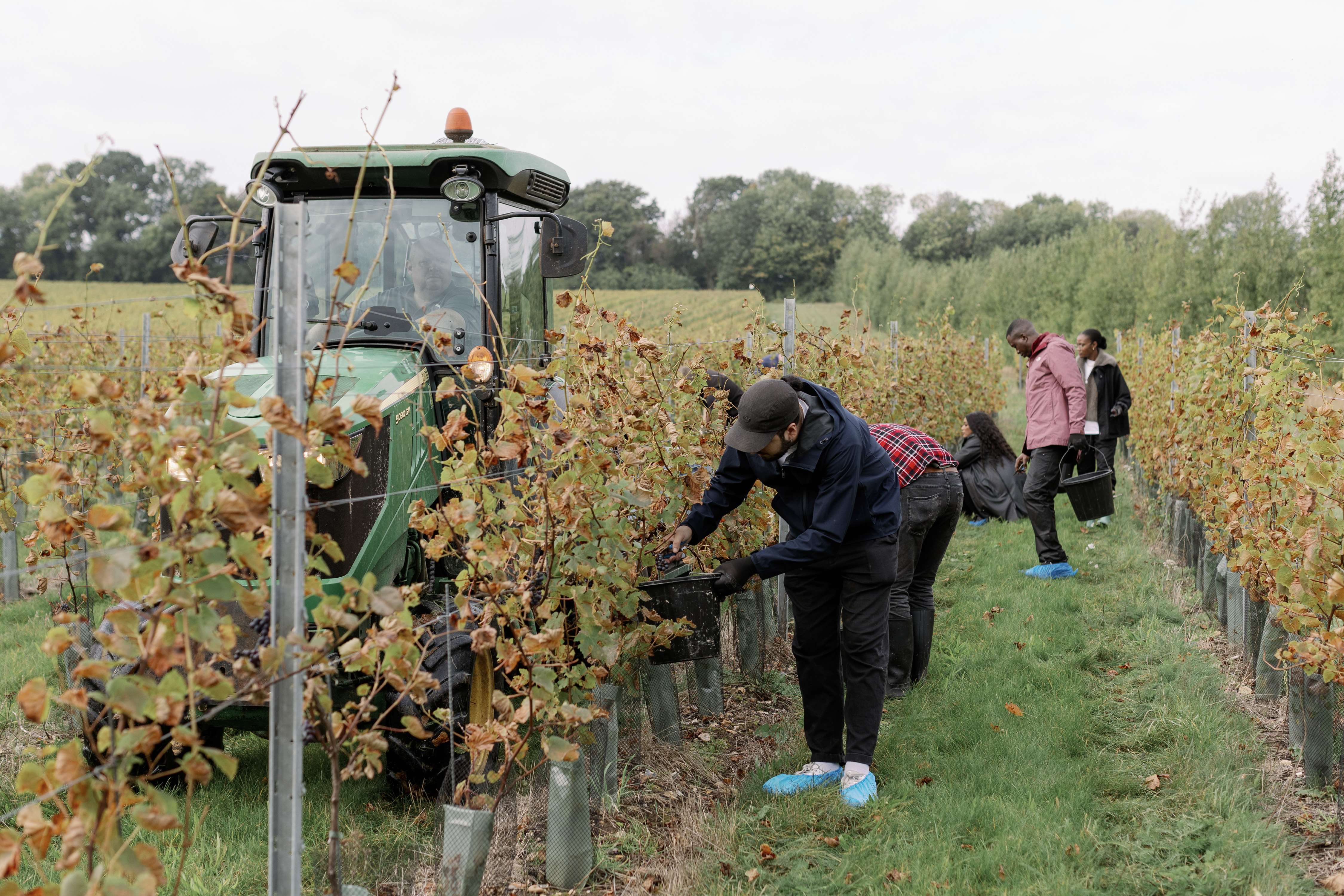
The poor summer meant that some vineyards pushed back their harvest, keen to secure as much further ripening as possible. Woodchester began their harvest later than any other vintage since they established their winery in 2016, and reported that it was ‘a challenge to find two consecutive dry days’ in which the grapes could ‘dry out before picking’. Hattingley also reported a ‘slightly delayed harvest’, while Knightor reported that they began their harvest ‘three weeks later’ than in previous years, with the first fruit coming in on the 28th September, and the last on the 28th October. It should be noted that not all vineyards reported a late harvest. New Hall harvested their final hand-picked bunch on October 4th, and finished their machine harvest a week later. Nyetimber also reported a ‘typical harvest start date of early October’. White Castle reported that, ‘while provisional harvest dates were getting later and later’, they were ‘forced to pick on 10th October’ due to a rare autumnal frost forecast for the 11th October.The frost indeed ‘came with a vengeance’, with temperatures falling to -4 degrees. Across the country in Essex, Saffron Grange reported a ‘pre-harvest frost’ on the same day as White Castle’s, the first in their history, with temperatures falling to -2.5 degrees. Other vineyards also reported autumn frost, with Albury noting that ‘an unusually early Autumn frost damaged the canopy and slowed the ripening process’. Most harvests were completed by late October, although some later harvesting vineyards, such as Simpsons, reported their final fruit being harvested in November.
Yields
The last few years have produced dramatically varying yields in England and Wales. 2021 and 2022 were both years of relatively small yields, while 2023 marked by far the largest harvest achieved in the UK. By contrast to the bumper crop in 2023, 2024 was always likely to be smaller. Nevertheless, the yields in 2024 proved, in many cases, significantly lower than was hoped. WineGB project that the total wine production across England and Wales in 2024 is likely to be around 6 to 7 million bottles, which WineGB notes represents a ’30-40% reduction on the 10-year production average (roughly 10 million bottles). In 2023, by contrast, England and Wales produced around 20 million bottles.
In keeping with this broader data, many of the vineyards who spoke to us reported significant drops in yield. Albury reported that their yield in 2024 was ‘40% lower than average’, with just 13 tonnes of fruit harvested from the main Albury site, in contrast to ‘the usual average of 20 [tonnes]’. Knightor similarly reported yields down by ’30-40% in most vineyards’. Some vineyards reported even bigger drops. Nutbourne noted that their yield was just ’26 tonnes’, in contrast to an average of ‘50-55’, and in particular to 2023, where they harvested over three times more fruit. White Castle meanwhile reported that ‘their volume was down by around 60% overall’, a particular disappointment given the recent instillation of a new winery.
There is little mystery around the causes of these lower yields. As Three Choirs glumly wrote, ‘you only have to look at the weather over the last 14 months to understand why’. While the broader poor weather and disease pressure over summer played a role, many vineyards zeroed in on difficult weather around flowering as a particularly significant factor. Burn Valley noted that they experienced ‘cold weather around flowering in June’, impacting subsequent yields, such that winemaker Matthew Abbey suggested he would have ‘expected double’ what was harvested. Woodchester and Oxney both drew attention to ‘poor flowering conditions at the end of June and early July’, leading to ‘smaller bunch weights’.
Regional Variation
It should be noted that there was a degree of regional differentiation in terms of yield. WineGB suggest that ‘the east of the country fared better due to prevailing weather patterns’, with the South-East performing best. Kent-based Balfour, for example, noted that 2024 represented their ‘second-highest yield on record’, with ‘over 500 tonnes of grapes reaching their winery’. Danbury Ridge in Essex reported ‘balanced yields’, while several vineyards, such as Yotes Court (also in Kent) suggested that, while their yields were ‘down by 35% compared with 2023’, their 2024 yield was nevertheless ‘more in line with an average year’.
It was also noted by a variety of producers that, alongside higher yields, vineyards in the East of England tended to produce a higher quality of fruit. Hattingley Valley, for example, noted that ‘their partner vineyards in the East of the country, Kent in particular, produced some of the most impressive results’. A similar observation was made by Balfour Hush Heath, who reported that ‘Eastern vineyards showcased the best of this challenging year’, while Defined Wine, one of England’s largest contract wine makers, observed that some vineyards in Kent and East Anglia ‘actually saw riper fruit than last year’.
Pests
There was a mixed picture in 2024 concerning pest damage. On the positive side, several vineyards reported fewer issues with insect and parasitic pests than in previous years. Hazel End noted that, ‘oddly, 2024 was a year without wasps’ (readers can let us know whether that was their experience!). Saffron Grange meanwhile noted that they ‘saw the decline of grapevine scale, a pest that enjoys feeding on the vine’s sap’. Saffron Grange attributed this decline to ‘a parasitic wasp which preys on them’, which they suggest is ‘a reminder of how important it is to focus on providing the adequate habitat for insects to thrive’. Particularly notable was the relative absence of spotted wing drosophila (SWD). Gusbourne noted that, as harvest approached, it became clear that damage from SWD was almost non- existent, which they attributed to the ‘cool, damp weather’. This was, they noted, a ‘boon’, as ‘these flies can cause huge damage to a crop’. For some vineyards, this was little consolation. When I asked about any good news from Three Choirs, winemaker Martin Fowke wrote ruefully ‘No spotted wing drosophila? I think they must have all drowned!’.
However, not all pest damage was avoided. One of the more surprising aspects of 2024 was the number of vineyards that reported bird damage. Data from WineGB’s Harvest Yield Survey shows that a startling 48% of vineyards who responded experienced late-season bird damage, and several vineyards testified to this in their reports. At Albury, the team had scarcely recovered from a late-autumn frost when there was ‘an influx of birds into the vineyard, predominantly wood pigeons looking for food’. Albury reported that they ‘suffered significant bird damage for the first time ever’, with ‘pigeons consuming three tonnes of Chardonnay in 48 hours!’. Albury report that this loss has prompted them to ‘consider how to deter birds next year’, with kites, balloons, nets, dogs, and even drones under consideration. Wood pigeons seem to have been particularly persistent offenders. Woodchester noted that, ‘while the wasps and fruit flies which plagued the harvest of 2023 did not make an appearance…the major threat to the fruit was birds’. Offenders included ‘pheasants from the neighbouring shoot, migrating starlings and, more unusually, a very large flock of woodpigeons’, resulting in ‘Hitchcock style’ scenes, and requiring ‘more nets than usual’. Several vineyards suggested that the voraciousness of the birds may have been due to the reduced availability of other crops, which similarly struggled with the challenging summer conditions.
Quality
It is likely clear to the reader at this stage that 2024 will not go down as one of England and Wales’ finest vintages. The lack of sunshine, and sheer quantity of rain, combined with poor weather during critical periods of flowering and harvest, made for one of the most difficult vintages in recent memory. I am grateful for the striking candour of several vineyards in their assessments of 2024. It was, as White Castle wrote, ‘the most challenging vintage in our 15 years of grape growing’, while Woodchester similarly wrote that 2024 had been an ‘extremely challenging harvest’. Chris Wilson at Gutter and Stars described it as ‘arguably the hardest harvest I’ve experienced since setting up Gutter and Stars in 2020’ and suggested that 2024 ‘was a year where most producers were simply happy to get through to November relatively unscathed’.
There was no clear consensus on which varieties fared best in 2024. Unsurprisingly, many vineyards reported that earlier-ripening, aromatic varieties, were most successful. Tim Wildman of ‘Lost in a Field’ noted that ‘in a challenging year such as this, the early ripening benefits of the German cross heritage varieties we work with really came into their own’. He noted that he had taken samples of Triomphe d’Alsace and Reichensteiner from an Essex vineyard in mid-October, which lab analysis showed had achieved Oechsle levels in the mid 80s. Several other vineyards reported that aromatic varieties had been more successful. Knightor suggested that their more successful varietals included Bacchus, Pinot Blanc and Riesling, while Nutbourne suggested that their aromatic varieties in particular should produce some good wines.

However, other producers drew attention to the success of classic varietals. Oxney’s winemaker Salvatore Leone suggested that his ‘highlight of the year’ was Pinot Noir from their Knut vineyard, which he noted had a ‘deep and interesting flavour’. Balfour Hush Heath similarly suggested that Essex Pinot Noir had been the ‘standout variety of this harvest’, with ‘excellent sugar levels and vibrant fruit character’. Hattingley Valley meanwhile suggested that their Pinot Meunier ‘was the best quality of the three classic varietals’, while Gusbourne noted that their Pinot Meunier was ‘especially pretty’. The picture for Chardonnay was similarly complicated. While WineGB data suggested that ‘Bacchus and Chardonnay performed particularly well’, Chardonnay was rarely singled out for praise in the vineyards who wrote to us, and some vineyards, such as Yotes Court and Three Choirs, reported that Chardonnay had actually performed poorly relative to their other varietals.
A common theme across producers was the high acid levels in 2024’s crop, with Saffron Grange drawing attention to ‘high acids, and in particular [high] malic acid’. Three Choirs similarly noted that ‘acids remained high in later [harvesting] varieties, but did drop eventually’. Sugar levels were generally a challenge across the country, with Three Choirs noting that ‘sugars were lower’, and even into September ‘didn’t climb as expected’. Oxney similarly reported that ‘sugars were low-ish’, although they noted that ‘maturity and phenolic ripeness were great’. For those vineyards who could manage it, leaving the fruit as much hang time as possible invariably yielded rewards. Oxney noted that ‘we took a chance and let the fruit hang for as long as our nerves could take it’ such that ‘the last day of picking was October 24th, the latest ever picking at Oxney’. Balfour similarly described a ‘strategy of extended hang time, leaving fruit on the vine as long as possible to benefit from any autumn sunshine’.
As a result, 2024 is likely to be, as Woodchester wrote, more of a ‘sparkling wine year’, than a ‘red wine year’. Several producers, including Knightor and Nutbourne, say they intend to make little or no still red wine from 2024, while Hattingley Valley suggest that their Pinot Noir ‘shows promise for the quality of sparkling rosé’. Several vineyards, including Gusbourne and Hattingley, also suggested that they would be dialling back the use of oak in 2024, in order to preserve the ‘delicate characteristics’ of the year’s fruit.
Conclusions
2024 wasn’t only a challenging vintage for England and Wales. Over the channel, French wine-making regions struggled with many of the issues detailed in this report, such as heavy rain and limited sunshine hours. On a recent visit to Burgundy, I frequently heard stories of heavy crop loss in 2024 (as much as 80% in some cases). Bordeaux similarly struggled with heavy rain (May saw 80% more rainfall than average), leading to slowed growth and increased disease pressure. The result was a substantial drop in wine production across France. In WineGB’s report for 2024, attention is drawn to the fact that “wine production in France fell by 23% compared to 2023, and dropped by 46%, 38%, 29%, and 12% in Champagne, Burgundy-Beaujolais, Loire, and Bordeaux respectively with reports of lower sunshine levels, excess rainfall, mildew, and botrytis”. Similar decreases were reported from Germany, Switzerland and Austria.
With its most southerly vineyards at least 100 miles north of Champagne, England and Wales were arguably even more at risk from these difficult conditions. The fact that so many English and Welsh vineyards were able to produce a good, albeit small, harvest, is striking, and speaks to the expertise at work across British vineyards. WineGB notes in their report that ‘industry maturity and understanding of vineyard management came to the fore’, with ‘expertise, resilience and selectivity in the vineyard resulting in many producers harvesting a small but good quality crop’. A clear example of this expertise is the extended hang-time strategy practiced by many vineyards in 2024. Leaving the grapes on the vine during the turbulent September and October weather was a high-risk strategy, requiring significant skill and attention to make sure the maximum ripeness was achieved without imperilling the grapes. Balfour Hush Heath, for example, had their lab ‘analysing up to 50 blocks in a single day to pinpoint optimal picking windows and inform daily harvest decisions’. Gusbourne similarly described how oenologist Mary Bridges and her team ‘continuously analysed fruit samples from across the sites, checking for the all-important uptick in sugar and waning of acidity levels which signal peak ripeness’. They describe how their ‘work focused on micro-parcels, meaning the pick was incredibly focused and precise’. The results were, Jon Pollard notes, ‘superb phenolic ripeness’.
Such attention to detail requires, of course, significant resources, and 2024 was undeniably a year where more established, more resourced vineyards may have been able to weather the conditions more successfully. This applies as much to winemaking as to vineyard management. Three Choirs, for example, notes that 2024 was ‘a year when investment in state of the art temperature control, new oak barrels, new press and gentle pumps should make a huge difference to the wines’, noting that ‘the smaller crop and a new, larger press allowed Three Choirs to separate juice fractions and start fermentations in smaller tanks using different yeasts and tanks to create different characteristics in the wines that will be invaluable when it comes to blending’. However, while these resources will doubtless have been advantageous, they are not the whole story. As one winemaker wrote to us, 2024 was ‘a year that sorted out those who had been on top of their vineyard work all season’, with practices such as canopy management and green harvesting all playing a crucial role alongside more high-tech approaches.
The first still wines from 2024 have already been released, and we have been impressed by those we have tried (we will, of course, have to wait rather longer for most sparkling wines). For those vineyards that navigated the tricky conditions successfully, 2024 should yield some high-quality wine, with good freshness and phenolic complexity. Quantities will be small, although the sizeable yields from 2023 should limit any major supply pressure. We are confident that, while 2024 is not a year to buy blind, there will be some great English and Welsh wines, and look forward to bringing them to our shelves.
*We’d like to thank all the vineyards who contributed testimonies and 2023 vintage reports. Their time, generosity and honesty are all deeply appreciated.*